
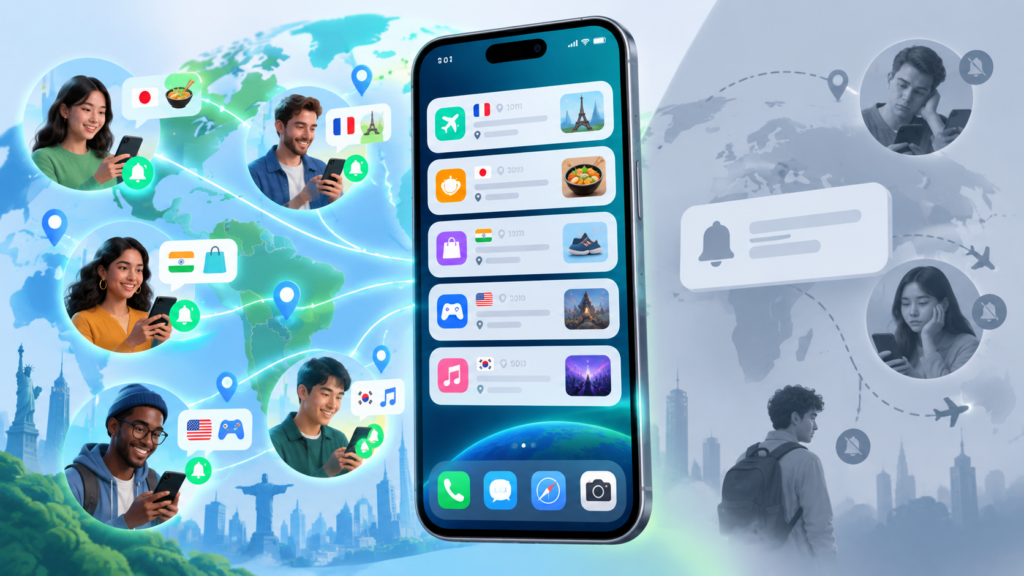
Key Takeaway: Push notifications are the highest-frequency touchpoint between mobile apps and international users, and unlocalized notifications are consistently among the most common reasons international mobile app users disable notifications or churn – yet most teams underinvest in this layer relative to UI or onboarding localization.
TL;DR: Push notification localization requires far more than running notification content through a translate workflow. It demands time-zone scheduling so messages arrive during acceptable local hours, cultural tone calibration to match market expectations, locale-specific personalization tokens for name formats and date conventions, regulatory compliance with regional opt-in laws like GDPR, and A/B testing infrastructure that operates per locale rather than globally. Generic English push notifications destroy international retention because they signal to users that they are not a priority audience. The technical foundation involves locale-aware delivery through FCM and APNs, template management systems with strings file support per language, and personalization token substitution. Mature product teams measure open rates, opt-out rates, and retention curves independently per locale to connect push performance to business outcomes.
Introduction
Push notifications are the highest-frequency direct communication channel between a mobile application and its users. Most apps send more push notifications than emails, in-app messages, or SMS combined. When those notifications arrive in the wrong language, at the wrong hour, with the wrong tone, international users do not file bug reports. They disable notifications or delete the app. The retention damage is real, measurable, and almost always misattributed to product-market fit issues rather than communication failure.
The scale of the problem is significant. Mobile apps operating across dozens of markets routinely send millions of notifications monthly, and many default to English regardless of device language or user locale. The assumption that translated UI screens and onboarding flows are sufficient ignores the reality that push notifications are what users see most often after initial setup. A notification that arrives at 3am local time in untranslated English tells the user everything they need to know about how much the company values their experience.
Push notification localization is one layer of a broader discipline. For teams new to the wider practice, mobile app localization guide walks through the end-to-end approach – from technical internationalization foundations through cultural adaptation and continuous localization workflows. This article builds on that comprehensive context with a specific focus on the push notification layer that most product teams underinvest in.
This article covers the specific mechanism by which unlocalized notifications kill retention, the six core components of proper push notification localization, the technical foundation developers need to build locale-aware delivery, cultural considerations that go beyond translation, common failure modes with real-world consequences, and a practical checklist for teams ready to fix this gap. Localizing notifications involves more than literal translation of text – it requires adapting to regional cultural nuances, scheduling logic, and compliance frameworks.
Why Push Notifications Are the Silent Killer of International Retention
Push notifications function as a frequency-based touchpoint. Unlike onboarding screens or feature pages that users encounter once or occasionally, notifications reach the device screen repeatedly – sometimes daily. Each notification is a micro-signal about how the app perceives the user. When that signal arrives in a language the user does not read fluently, or during hours when they are sleeping, the message it communicates is clear: you are not a first-class user.
The behavioral response follows a predictable pattern. Users first ignore notifications, then disable them at the OS level, and eventually uninstall. Research published in 2024 found that sending one push notification per day tends to increase customer attrition, while approximately three per week with relevant targeting often yields the highest effectiveness. When notifications are both too frequent and irrelevant due to poor localization, the compounding effect accelerates churn.
Retail app data shows the retention gap starkly. Push-notification-enabled cohorts maintain roughly 50% retention on iOS and around 38% on Android, compared to near-zero retention when notifications are disabled. International markets typically show larger retention drops than English-speaking markets because the localization gap is wider. These drops are measurable but teams commonly attribute them to product issues, competitive dynamics, or market maturity rather than examining the notification layer. Customized user preferences for notifications improve engagement and reduce opt-outs, but most teams never build the infrastructure to support this per locale.
What Localized Push Notifications Actually Require
Localizing push notifications involves six core components, and most teams only address the first one – if that.
- Translated text is the obvious layer. It requires high-quality human translation or professionally reviewed machine translation that accounts for idioms, gendered language, pluralization rules, and text direction. A key string in your default language needs a corresponding entry in every supported locale. Automated translation reduces manual localization efforts significantly, but quality review remains essential.
- Time-zone scheduling ensures messages arrive during acceptable hours in the user’s local time. Scheduling messages according to local time zones improves notification engagement and prevents the 3am delivery problem that drives opt-outs.
- Cultural tone calibration adjusts the register, urgency level, and communication style per market. Localized urgency and value drivers differ across cultures and should be tailored rather than applied universally.
- Locale-specific personalization tokens handle name order, honorifics, date formatting, currency symbols, and units. Push notifications should match the user’s device preferences for language and formatting, including details like whether the display shows “First Last” or “Last, First.”
- Regulatory compliance addresses opt-in requirements that vary by jurisdiction. Push notifications must comply with regional data privacy laws like GDPR, and France’s ANJ and CNIL published specific guidance in May 2026 treating marketing push notifications as regulated commercial communications.
- A/B testing infrastructure per locale enables teams to test copy variations, delivery timing, and frequency across markets independently. Use A/B testing for localization differences, not just the original English copy.
The Technical Foundation: Delivery, Scheduling, Personalization
Building locale-aware push routing requires backend infrastructure that connects user locale data to notification delivery logic. Effectively localizing push notifications requires matching device language settings, which means your system must store and access locale preferences per user and per device.
On the delivery side, iOS push notifications rely on APNs (Apple Push Notification service) while Android apps use FCM (Firebase Cloud Messaging). Push notifications can be localized using title_loc_key and body_loc_key on Android, with corresponding loc_args for dynamic values. On iOS, developers use loc-key and loc-args within the payload, and iOS requires Localizable.strings files for each supported language. Android localization uses strings.xml files for each language – for example, values-fr for French and values-es for Spanish. The title loc args and loc args allow dynamic content insertion without hardcoding translated text in the payload itself.
Template management is where platforms like OneSignal, Braze, and similar services add value. OneSignal detects user language preferences automatically and supports over 40 languages with templates defined per locale. Dynamic language detection enhances user experience by displaying translated copy automatically. Gridly automates Android push notification localization, reducing the operational burden of managing strings across many locales.
UNNotificationServiceExtension allows modifying notification content before delivery on iOS, which is critical for locale-aware processing. The extension runs independently of the main app, is triggered by the mutable-content key in the payload, and allows for asynchronous processing of notification content. Developers can implement custom logic for notifications using the extension – for example, fetching localized media or adjusting the title string based on stored user preferences.
Time-zone conversion and scheduling logic must account for daylight saving changes, user travel, and device time configuration. Intelligent delivery features – sending when each user is most likely to engage – layer on top of basic timezone awareness.
Cultural Considerations Per Market
Translation handles language. Cultural adaptation handles meaning. The distinction is the difference between a notification that is technically readable and one that feels native.
Formal versus casual register varies dramatically. Japanese notifications typically require formal verb endings and honorifics. German consumers expect direct, factual tone without excessive warmth. Latin American Spanish tends toward relational warmth and softer calls to action. Korean communication demands careful attention to honorific levels that have no direct English equivalent. Localization should account for cultural differences in tone and communication style – what reads as friendly enthusiasm in American English can register as unprofessional in certain markets.
Emoji usage patterns differ by region. Many Asian markets, particularly Japan and Korea, use emoji widely and expect them in casual communication. Some European markets treat emoji in push notifications as a signal of low-quality marketing. Cultural nuances and imagery should align with local customs to avoid negative connotations. The same principle applies to rich media – images in notifications must be culturally appropriate, and action button text must render correctly for RTL languages like Arabic.
Urgency signaling creates another divergence point. Phrases like “last chance” or “today only” drive action in some markets and trigger spam perception in others. Localized messages should consider local holidays, events, and seasons rather than applying a global promotional calendar. Local notifications should respect local user habits, avoiding late-night alerts – and the definition of “late night” itself varies by market.
Push campaigns should consider user preferences for notification frequency and types. Some cultures tolerate daily notifications for apps they value; others find more than two or three per week intrusive regardless of content quality. Cross-cultural UX research from Nielsen Norman Group consistently documents how notification patterns, formality expectations, and message frequency tolerance differ across regional user bases. Their published research remains one of the most cited independent sources on how mobile UX must adapt to cultural context, and their findings map directly to push notification design decisions.
Common Push Notification Localization Failures
Five specific failure modes account for most push localization damage in production.
Translation without timing adaptation. Teams translate notification content into multiple languages but send all messages according to headquarters’ time zone. Users receive correctly translated notifications at 3am local time. The translation effort is wasted because the user disables notifications after the second disrupted night.
Complete time-zone scheduling neglect. Some apps send all notifications simultaneously worldwide. One case study from the language-learning app Drops documented that generic global push messages were driving nearly one-third of iOS users to opt out. When they rebuilt the push engine with time-zone-aware, context-targeted messages, engagement and retention improved measurably.
Universal emoji and tone strategy. Applying the same exclamation-heavy, emoji-dense copy across all markets creates a mismatch in regions with more formal communication norms. What performs well for American mobile app users can fail entirely in Japanese or German markets.
Identical frequency across cultures. One global send schedule ignores that frequency tolerance varies. Sending daily promotional notifications to users in markets that expect weekly contact at most leads to rapid opt-outs. Testing notifications with local users ensures cultural fit and effectiveness before scaling.
Rich content localization oversights. Action buttons displaying “Shop Now” in English when the user’s locale is Korean, or notification images that carry cultural meaning inappropriate for the target market, undermine the entire localization effort. Developers who localize the message string but leave buttons and media in the default language create an inconsistent experience that erodes trust.
Best Practices for Push Notification Localization
- Store notification templates in your localization platform alongside UI strings, with version control and native speaker review for tone and cultural appropriateness – not just translation accuracy
- Use locale-aware scheduling by default, delivering at local times and offering intelligent delivery that sends when each user is most likely to engage
- Test cultural tone per market with native reviewers or in-market feedback groups rather than relying solely on translators to define the right register
- Calibrate notification frequency per locale based on per-market opt-out rates, open rates, and retention data – performance metrics for localized notifications should be tracked independently
- Localize rich content including images, action buttons, and media elements, ensuring correct rendering for all script directions and cultural contexts
- Measure per-locale notification metrics separately: open rate, click-through rate, opt-out rate, and retention curves at Day 7, Day 30, and Month 3
- Include push templates in your continuous localization pipeline so new notification types and features are localized before release to production
Frequently Asked Questions
What is push notification localization?
Push notification localization is the process of adapting push notification content, delivery timing, tone, personalization tokens, and frequency for different user locales. It goes beyond translation to include cultural calibration, time-zone scheduling, regulatory compliance, and locale-specific testing. Storing localized user data aids in tailoring notifications effectively.
Should I translate push notifications with machine translation?
Machine translation can serve as a starting point to create drafts quickly, but professional review by native speakers is strongly recommended. Automated translation reduces manual localization efforts significantly, though unreviewed machine output risks cultural mismatches, awkward phrasing, or meaning errors that damage user trust. Better content comes from human review of machine-generated drafts.
How do time zones affect push notification localization?
Push notifications should be scheduled based on the recipient’s local time zone to avoid delivery during sleeping hours or culturally inappropriate times. Without timezone logic, a notification sent at 10am in your headquarters’ timezone might arrive at 3am for users in another market, which is among the most common reasons for notification opt-outs.
What is a good open rate for localized push notifications?
Benchmarks vary by category and market. Many teams find that properly localized notifications achieve open rates significantly higher than generic sends – some data suggest localized notifications can drive engagement rates 160% higher than unlocalized equivalents. Push notification engagement increased 38% year over year for Android apps when localization and personalization were applied. Track per-locale metrics rather than relying on global averages.
Which push notification platforms support localization natively?
FCM (Firebase Cloud Messaging) and APNs provide foundational delivery with payload-level localization support including title loc key, loc key, and args fields. Platforms like OneSignal and Braze add template management, automatic language detection, multi-language messaging, intelligent delivery, and frequency capping on top of these services. Evaluate based on your team’s development resources and the number of locales you support.
How do you measure push notification performance per locale?
Track open rates, click-through rates, opt-out rates, uninstall rates, and retention curves segmented by locale and language. Compare cohorts receiving localized versus generic notifications within the same market. Measure notification permission grant rates by locale to understand opt-in conversion, and run A/B tests per locale to isolate which copy, timing, and frequency variables drive success in each market.
Conclusion
Push notifications remain the most underinvested localization layer in most mobile apps, despite being the highest-frequency signal international users receive about whether they matter to the product. Every unlocalized notification is a small point of friction that compounds into notification disablement, disengagement, and churn. Teams that localize push properly – addressing not just language but timing, tone, frequency, and compliance – consistently see measurable retention lift in international markets. The competitive advantage belongs to product teams that treat push notification localization not as a nice-to-have but as a core retention mechanism for every market they operate in. The tools, platforms, and testing frameworks exist today. The gap is in prioritization.