

A supplier in Vietnam, a client in Germany, a payout to a contractor in Brazil – and your bank wants three to five business days and a fee that makes the whole thing feel like 1995. The money takes longer to arrive than the email confirming the deal.
Crypto payment infrastructure does not fix every problem in global business finance. But it solves one problem: moving money across borders without waiting on banks, currency desks, and payment systems that aren’t modern. More businesses are taking a serious look at it now – not as something to make money from, but as the way money moves from one place to another.
Why Traditional Cross-Border Payments Need Modernization
The wire transfer system works. It also charges you for working, takes days to settle, and doesn’t show you where your money is between when you send it and when it arrives. None of that matters if you are paying someone in your own country and the money is going from one account in the same bank to another. For a business that pays suppliers in six countries every month, it can get expensive very quickly.
A few things that haven’t changed in decades cause the problems. When you use a bank that works with another bank, there are extra people involved in the process, and each one makes a profit. The money is converted at a rate that you didn’t set. Payments to some markets, like Southeast Asia, Latin America, and some parts of Africa, can sometimes fail or get stuck without any clear reason. To reconcile what left your account with what arrived on the other side, someone has to check the details manually.
These are all normal situations. These are normal for any business that operates in more than one country. They mean the business is losing money because of how it is run, not because of what it makes.
How Crypto Payment Infrastructure Works
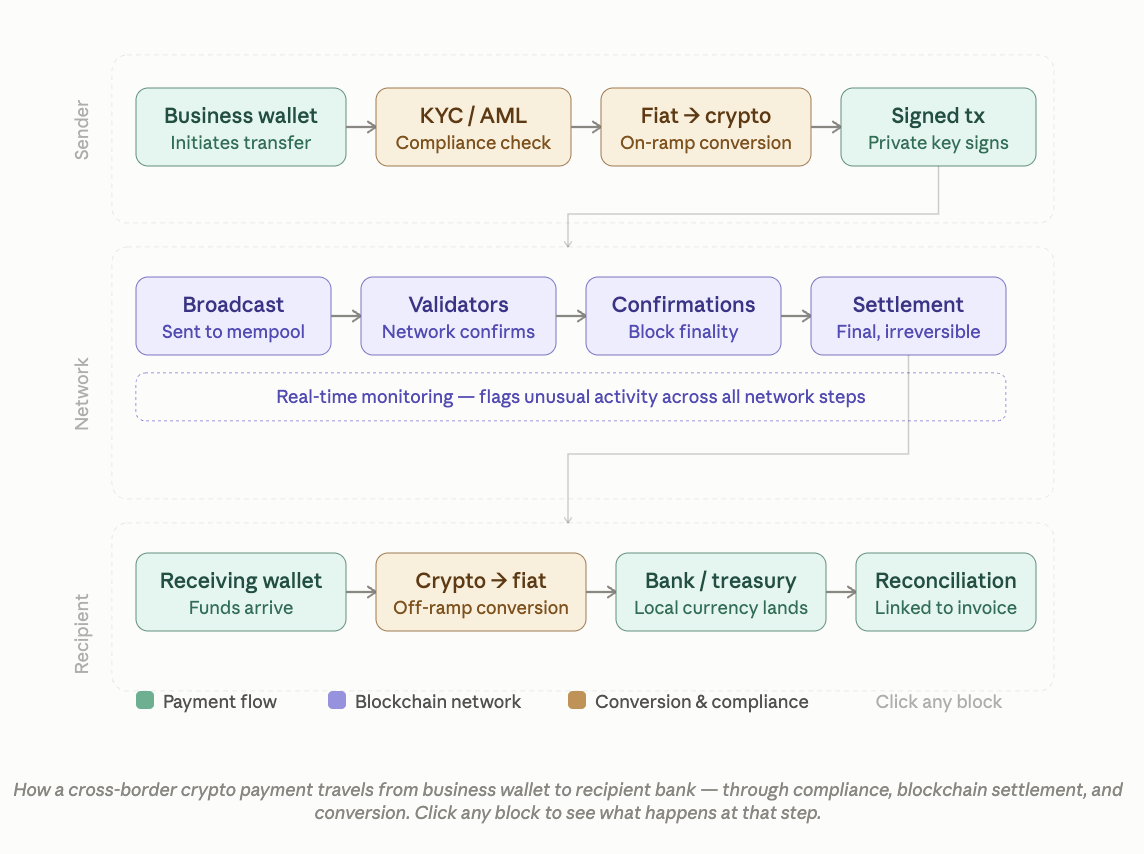
The main idea is simpler than the words used to describe it. Instead of telling a bank to move money around, crypto infrastructure moves value directly on a shared network that both the sender and the recipient can see. The transaction is recorded publicly, and the network confirms it. Neither party needs to trust an intermediary to get it right.
For a business, there are also practical things to consider. These include things like wallets to hold and receive funds, tools to convert between currencies, and accounting and compliance reporting. It’s also important to control who in the company can do what with the money. That combination of network and business tooling is what crypto payment infrastructure actually means in practice.
Payment Processing and Blockchain Settlement
When a business receives a crypto payment, the sender sends a transaction to the network. The people who check that everything is working correctly (called ‘validators’) confirm this. The number of confirmations needed depends on the network and the platform, and then the money appears in the receiving wallet. On faster networks like Solana, this only takes a few seconds. With Bitcoin, it usually takes ten to thirty minutes for the payment to be confirmed.
The settlement is the confirmation. There is no separate clearing cycle, end-of-day batch, or bank holiday delay. The transaction either confirms or it doesn’t, and both parties can see the status in real time without calling anyone.
Crypto-to-Fiat and Fiat-to-Crypto Conversion
Most businesses don’t want to hold crypto. They want to receive it, convert it, and have the local currency go into their bank account. On-ramp and off-ramp solutions handle that step – converting between crypto and traditional currencies at the point of receipt or payout.
Stablecoins make this process even easier. A business can receive USDC (a digital dollar that doesn’t change in value) and hold it as long as needed before converting it. This means the business doesn’t need to stay in crypto longer than necessary. Many international payments now use stablecoins because they are as fast as crypto but have a fixed dollar amount.
Benefits for International Businesses
The advantages are operational, not speculative. Businesses that use crypto infrastructure for cross-border payments typically point to the same improvements:
- Faster settlement. Payments that took three to five days arrive in minutes or hours, which matters for cash flow and supplier relationships.
- Lower transfer costs. Cutting correspondent banks from the chain removes the fees that stack up on each international wire.
- Wider reach. Markets that are hard to pay into through traditional banking become reachable.
- Better visibility. Every transaction is recorded on a public ledger. Both parties can check the status without waiting for a bank to reply.
- Predictable costs in stablecoins. Paying or receiving in USDC removes the uncertainty around currency conversion, which can complicate international invoicing.
- Programmable controls. You can add rules about approvals, spending limits, and permissions based on roles directly into the payment layer. This means you don’t have to do things manually.
Traditional vs Crypto Cross-Border Payments
The difference between the two approaches is clearest when you put them side by side and look at the factors that actually affect day-to-day operations.
|
Factor |
Traditional wire transfer |
Crypto infrastructure |
|
Settlement time |
1–5 business days |
Seconds to 30 minutes |
|
Transfer fees |
$15–$50+ plus correspondent fees |
Network fee, typically under $1 |
|
Currency conversion |
Bank rate, spread often opaque |
Market rate, transparent off-ramp |
|
Transaction visibility |
Limited, requires bank confirmation |
Real-time, public ledger both sides see |
|
Market reach |
Depends on correspondent banking |
Any wallet address, globally |
|
Weekend transfers |
Delayed until next business day |
Network runs continuously |
|
Access controls |
Bank-side, limited customisation |
Role-based, multi-approval, programmable |
Typical conditions. Actual fees and settlement times vary by provider, network, and destination.
The table doesn’t tell the whole story. Wire transfers follow the same banking rules as other payments and include dispute mechanisms. This is still important when you’re dealing with someone new and the amount of money being exchanged is high. The best answer for most businesses isn’t one or the other–it’s knowing which situations suit each rail.
The Technology Behind Secure Crypto Transactions
Crypto transactions are secure because they use something called public and private key pairs. These make it hard to fake or intercept a payment. But for a business, the most important security layer is the one on top. This layer controls access to wallets and payment tools. It also determines who can approve transactions and how the system flags unusual activity.
Wallet Security and Access Controls
A business wallet is different from a personal wallet. One seed phrase, one device, one person who knows the password – that setup does not belong in a company where funds belong to the organisation and multiple people need access. This is because the company has multiple people who need access and the funds belong to the organisation. Business-grade setups separate the ability to view balances from the ability to move funds. They also require more than one person to approve significant transfers and log every action against an individual account rather than a shared login.
Keeping the private key safe is a problem in itself. If someone gets hold of your keys, they can access them. Hardware wallets, MPC custody, and managed custody solutions each handle this differently, but the idea is the same: the thing that controls the money should not be in the same place as the day-to-day business.
Transaction Monitoring and Regulatory Compliance
If you use crypto to do business in other countries, you have to deal with lots of different rules and laws. AML and KYC procedures are not optional–they are the cost of using the global financial system, and business-grade crypto payment infrastructure includes them as standard. Real-time monitoring flags unusual patterns before they become problems. Auditors and tax authorities need accurate records of every transaction. These records include the amounts, timestamps, counterparties, and exchange rates at the time of receipt. Without proper infrastructure, a business will have to produce these records after the fact, which can be very difficult.
How to Choose a Crypto Payment Infrastructure Provider
The difference between providers is not just the currencies they support. It’s in the business tools that are built around the payment layer. Before choosing a platform, think about what your business really needs:
Cryptobanco is built for businesses managing crypto payments and global financial operations – treasury management, cross-border payouts, and the compliance layer that international operations require.
The Future of Cross-Border Business Payments
The direction is clear: faster settlement, lower friction, and more markets reachable without a local banking relationship. Speed is less certain, and it depends on the rules as well as the technology.
Most major jurisdictions are moving toward clearer crypto rules, not away from them. This makes it easier for businesses to build international payment operations on crypto rails. It also makes compliance easier and reduces the risk of operating in a grey area.
For a long time, traditional banks and crypto infrastructure will exist together, and for most businesses, that’s OK. The smart move is not to swap one for the other, but to use each when it works better. Before choosing a platform, you should map your actual transaction flows. This means mapping where the money goes, in what volumes, to which countries, and what the current cost and delay look like. That map shows you exactly where crypto infrastructure earns its place – and where it wouldn’t change much at all.