
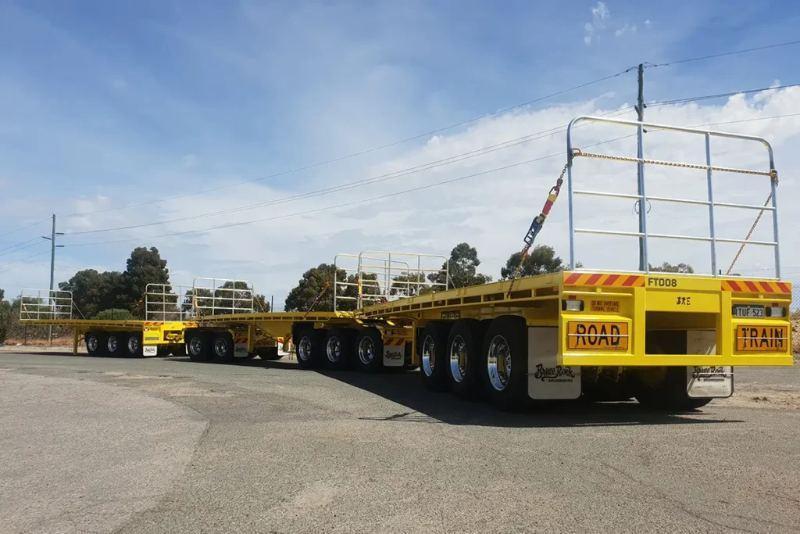
Image source: https://brucerockengineering.com.au/flat-tops-drop-decks/
Every transport operator eventually runs into the same fork in the road: does this job call for a flat top or a drop deck. It sounds like a simple spec question, but get it wrong and you are either burning money hauling fresh air on an oversized deck or scrambling for a permit because a piece of equipment sits too high for the road corridor. Anyone weighing up flat top and drop deck trailer configurations for the first time is really asking a more specific question: what does my freight actually need, and what does it cost me to get that wrong.
The two designs solve overlapping but distinct problems, and the difference comes down to deck height, how freight gets loaded, and what shape that freight takes. None of that is complicated once it is laid out properly, but plenty of fleets still spec trailers based on habit rather than the load profile in front of them.
Deck Height Changes What You Can Legally Carry
A flat top trailer runs a single, level deck at a fixed height off the ground, generally sitting higher than a drop deck because there is no drop between the front axle group and the main deck. That higher deck is fine for freight that is not particularly tall, but it eats into the overall height budget fast. Once you stack a load on top of an already-elevated deck, you can find yourself brushing up against overheight limits sooner than expected, especially with anything bulky.
A drop deck, sometimes called a lowboy in casual conversation, steps down after the gooseneck section so the main deck sits much closer to the road. That drop is the entire point. It buys back height clearance, which matters enormously when the cargo itself is tall, whether that is an excavator, a shipping container stacked with gear, or fabricated steel structures. The lower deck means a taller load can still travel under bridges and overhead lines without tripping into escort or permit territory. For freight that is wide or heavy but not tall, the extra deck height of a flat top rarely causes a problem. For freight that is genuinely tall, the drop deck is often the only sensible option.
Loading Methods Rarely Get Discussed Until They Become a Problem
The other practical divide is how freight actually gets onto the trailer, and this is where a lot of buyers get caught out after the fact. Flat tops are built around forklift and crane access. Palletised goods, crated freight, steel coils, timber packs, anything that can be lifted and set down cleanly, suits a flat top because the deck presents as one continuous, unobstructed surface at a consistent height, which makes forklift tine placement and crane rigging straightforward.
Drop decks introduce a step in the deck profile, which changes the loading approach for wheeled or tracked equipment. Rather than lifting a load on, operators typically drive equipment up onto the deck using ramps, taking advantage of the lower deck height to keep the loading angle manageable. That drive-on approach is what makes drop decks the default choice for excavators, loaders, graders and other rolling stock that cannot practically be craned. It also tends to work against palletised freight, since a stepped deck with a gooseneck section is a less efficient use of space for stacked pallets than a flat, uninterrupted surface.
Matching the Trailer to the Freight, Not the Other Way Around
The honest answer to which trailer is "better" is that the question is framed wrong. A flat top earns its keep on general freight runs: pallets, machinery parts, building supplies, anything that loads by forklift or crane and does not push height limits. It is generally simpler to load, and its flat, unbroken deck makes it a versatile workhorse for operators who move a wide mix of freight types week to week.
A drop deck earns its keep the moment height becomes the limiting factor, or the load needs to be driven on rather than lifted. The trade-off is that a drop deck's stepped profile and lower deck section are not ideal for palletised freight, and its design leans specifically toward equipment and machinery transport rather than general cargo.
Fleets that run a genuine mix of freight types often end up needing both, because trying to force one trailer type to cover every job usually means compromising on load height clearance one week and loading efficiency the next.
Getting the Decision Right From the Start
This is ultimately a question of matching deck height and loading method to the freight itself, not a debate over which configuration is objectively superior. Operators moving predominantly palletised or crated general freight are almost always better served by a flat top. Those regularly transporting tall equipment, or freight that needs to be driven rather than lifted into place, will get more consistent, compliant results from a drop deck.
Bruce Rock Engineering builds both configurations using SSAB Hardox and Strenx wear-resistant steels, reflecting its dual accreditation in the Hardox In My Body and My Inner Strenx programs, with an eye to keeping tare weight down without sacrificing durability under the kind of punishment Australian routes hand out. For an operator working out which side of that flat top versus drop deck line their freight actually sits on, the manufacturer's own comparison of the two ranges is a practical place to start narrowing down the right fit, and Bruce Rock Engineering's decades building trailers for Australian conditions means the advice comes from people who have watched both designs earn their keep in the field.