

A power bank keeps your phone useful when your day lasts longer than its battery. For anyone who relies on digital tickets, navigation, mobile payments, and messaging, having a portable charging option can prevent a low battery from disrupting ordinary plans.
Its value becomes clear during the gaps between reliable charging opportunities: a long commute, an afternoon of appointments, or an evening out after work. You can add power while continuing your day, without finding a seat beside an outlet or returning home for a charger.
A Phone Battery Supports More Than Screen Time
Running out of battery affects more than entertainment. Your phone may hold the ticket for your journey home, the address of your next appointment, and the conversation explaining where to meet someone.
Consider a day that starts with navigation, continues with calls and photos, and ends with a digital ticket at a venue. Each task may seem small, but together they can use more energy than your usual routine. A phone that comfortably lasts through a quiet workday may struggle with that schedule.
A power bank provides room for those changes. You can accept an invitation after work or take a longer route home without immediately calculating whether your phone will survive the evening.
The most useful habit is to charge before the battery becomes critically low. Connecting during a lunch break or train ride leaves you better prepared for the hours when you need to keep your phone in hand.
Charging Can Fit into the Time You Already Have
Wall charging requires a suitable place to stop. Portable charging can happen during time you are already spending elsewhere.
That difference matters when charging opportunities are brief. Twenty minutes between appointments may not be enough to refill a phone, but a useful top-up can carry it through the next part of the day. This makes compatible fast charging valuable even for people who rarely need multiple full recharges.
Capacity and charging speed deserve separate consideration. Capacity determines how much energy the power bank stores. Output determines how quickly it can deliver that energy, within the limits supported by the connected device and cable.
For everyday use, a convenient connection can be as important as either specification. An integrated cable removes the need to find a separate one in your bag. A retractable design lets you extend it while charging and store it neatly afterward. Those details make it easier to use a short charging opportunity.
One Battery Can Support Several Daily Essentials
A phone may be the main reason to carry portable power, but compatible earbuds, e-readers, tablets, and other USB devices can also benefit.
For a student, that might mean topping up a phone between classes and charging an earbud case before the journey home. For someone working away from a desk, it could mean adding power to a tablet during a break.
This is where connection options become useful. Count the devices you actually carry and consider whether they need charging together. Multiple ports offer flexibility, but a power bank may divide its available output between them. The maximum single-port rating does not necessarily apply to every connection simultaneously.
Laptop charging requires more attention. A laptop needs a compatible charging connection and sufficient output, so a small phone-focused battery should not automatically be treated as a replacement for its regular charger. If laptop charging is a frequent requirement, it should guide the purchase from the beginning.
Everyday Convenience Depends on Carrying the Right Size
The largest power bank is not automatically the most useful daily companion. Weight, shape, and cable storage determine whether it earns a permanent place in your bag.
A compact 5,000mAh model can suit occasional phone top-ups. Around 10,000mAh is a practical starting point for longer days and more frequent phone use. Larger capacities become worthwhile when you regularly support several devices or spend extended periods away from charging points.
Advertised capacity should not be treated as an exact number of phone recharges. Voltage differences, conversion losses, and using the phone while charging all affect the result. The better question is whether the battery provides enough reserve for your usual day without becoming inconvenient to carry.
Think about where it will go. A bag-friendly shape may matter more than fitting into a tight pocket. A built-in cable can reduce loose accessories, while a numerical battery display makes it easy to check the remaining charge before leaving.
A Small Routine Keeps It Ready
Portable power works best when recharging it becomes part of an existing habit. After a day of heavy use, put the power bank beside your phone charger, then return it to your bag once it is ready.
Pay attention to its input rating as well as its output. A fast-charging power bank can still take longer than expected to refill when connected to a low-power wall adapter. Using a suitable adapter and cable helps make overnight or between-outing recharging more convenient.
Keep it away from prolonged heat and replace damaged charging cables. These are simple steps that help keep a frequently carried accessory dependable.
Conclusion
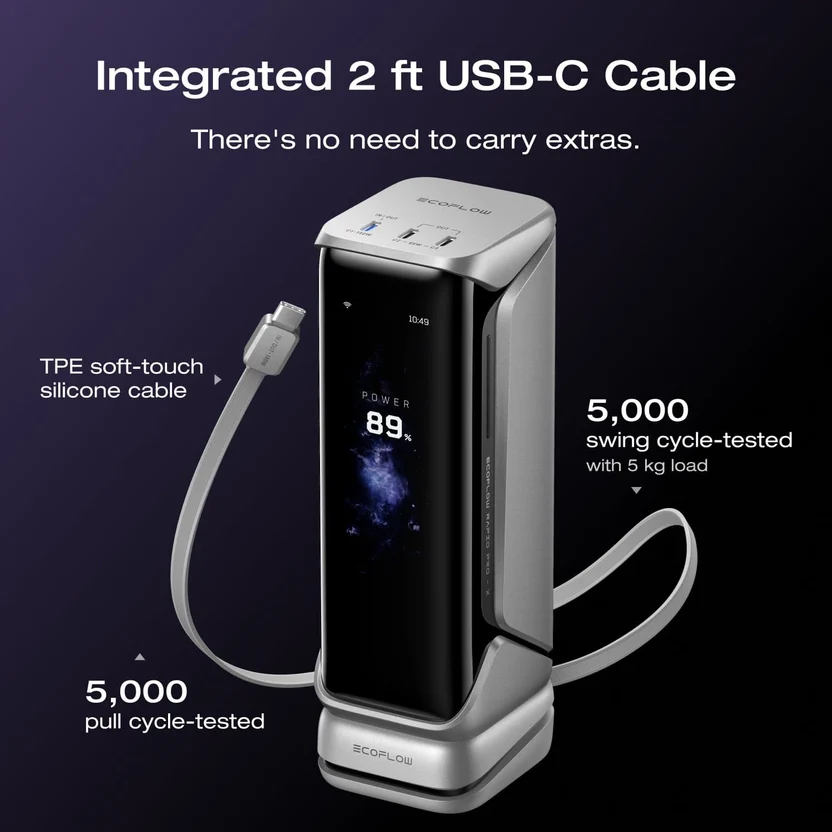
For daily commuting and outings centered on a USB-C phone, I recommend the EcoFlow RAPID Power Bank (10K, 45W, Retractable Cable). Its 10,000mAh capacity provides a useful everyday reserve, while the built-in 70cm USB-C cable makes charging straightforward without packing another lead. It weighs no more than 230g, offers up to 45W output for compatible devices, and includes a digital battery display.
Those features make it a practical power bank for a daily bag: enough flexibility to handle changing plans, a connection that is always attached, and a clear way to check what remains before heading out. For phone-focused use, that combination is more useful than carrying extra capacity you seldom need.