

Building a mobile app on a startup budget usually forces a hard choice: ship on iOS first, ship on Android first, or pay two teams to build both at once. Flutter removes that choice. One codebase compiles to both platforms, so a small team launches everywhere at the same time and spends the savings on growth instead of duplicate engineering. That is why early-stage founders keep reaching for it in 2026.
Key takeaways:
- One Flutter codebase ships to iOS and Android, cutting build cost roughly 30-40% versus separate native apps.
- Code reuse across platforms runs 70-90%, so one team replaces two.
- Hourly rates vary sharply by region: US $50-150, Eastern Europe $30-70, India $20-65.
- Typical cost: simple MVP around $10K, mid-range app $30K-80K, enterprise $150K+.
- Maintenance on one shared codebase costs about 40% less than two native ones, and the gap widens in years 2-3.
Why Are Startups Choosing Flutter to Control App Costs?
Flutter is Google’s open-source UI toolkit for building apps from a single Dart codebase. For a startup, that matters because engineering payroll is the largest line item in most early app budgets, and one Flutter team covers ground that once required separate iOS and Android crews. The result is faster launches and lower spend at the exact stage when cash is tightest.
If you are mapping out who to bring on and how to structure the work, a practical reference on how to hire Flutter developers walks through the engagement options.
One codebase instead of two native teams
A native build needs Swift work for iOS plus Kotlin work for Android. That usually means two specialists, two sets of bugs, and two release pipelines. Flutter collapses both into one Dart codebase, so a single developer or a small team ships to the App Store and Google Play together. Code reuse across the two platforms typically runs 70% to 90%, which is exactly where the staffing savings come from.
Faster time to market on a fixed budget
Speed is its own form of cost control. When you build once and launch on both stores at the same time, you validate the idea sooner and burn less runway getting there.
Flutter holds roughly 42% developer adoption among cross-platform frameworks in 2026, so the hiring pool and the package ecosystem are deep enough to keep that pace. For a startup testing product-market fit, shipping in months rather than quarters can decide whether the next funding round happens.
How Much Does It Cost to Hire Flutter Developers in 2026?
The honest answer is that it depends on where your developers sit and how senior they are. Globally, Flutter developers bill roughly $20 to $150 per hour in 2026, and the spread comes down mostly to region and experience. Here is how that breaks down so you can match a rate to your scope.
Hourly rates by region
Region is the single biggest lever on cost. North American developers sit at the top, while Eastern Europe, Latin America, and Asia offer comparable seniority for far less.
The table below compares typical 2026 hourly ranges across four common hiring regions.
|
Region |
Typical hourly rate |
Notes |
|
North America (US/Canada) |
$50-150 |
Premium in SF and NY can reach $180 |
|
Eastern Europe |
$30-70 |
About 38% below US for similar seniority |
|
Latin America |
$25-70 |
Strong overlap with US time zones |
|
Asia (India-led) |
$20-65 |
Largest Flutter talent pool |
Methodology: ranges compiled from 2026 Flutter rate guides published by index.dev and lemon.io, covering vetted contract and freelance developers.
What seniority actually changes
Seniority sets the rate inside each region. Senior developers who handle native integration and release engineering price at $65 to $100 per hour in the US, while mid-level rates plateau closer to $45 to $55. A lean MVP rarely needs an all-senior bench, so one senior to set architecture plus a mid-level to execute often covers the work without paying premium rates across the whole team.
Project cost by scope
Scope sets the budget more than any single rate does. Rather than one blended number, it helps to think in bands:
- Simple MVP: around $10,000 for a core feature set and a single user flow.
- Mid-range business app: $30,000 to $80,000 for multiple flows, integrations, and a backend.
- Enterprise platform: $150,000 and up for complex logic, scale, and compliance.
Where Do the Real Savings Show Up?
The headline number is the upfront build, where Flutter typically lands 30% to 40% cheaper than separate native apps. The larger win is quieter. It shows up in maintenance, where one shared codebase keeps costing less every year you run it.
Lower upfront build cost
Building one app instead of two cuts the initial development bill by roughly 30% to 40% compared with dual-native work, according to 2026 market guides. You pay for a single design pass, a single test cycle, and a single codebase to debug. For a first release, that is often the difference between affording a polished launch and shipping something rough.
Maintenance and the multi-year gap
Maintenance is where the model really pays off. Support and upkeep on a Flutter app run about 40% lower than maintaining two native codebases, because every fix and feature lands once.
The gap widens in years two and three. A dual-native team is still paying two engineers to keep two codebases in sync, while a Flutter team ships the same update a single time. Over a typical app’s life, that compounding saving usually dwarfs the upfront discount.
The graph below illustrates how the cost gap between Flutter and dual-native widens over three years.
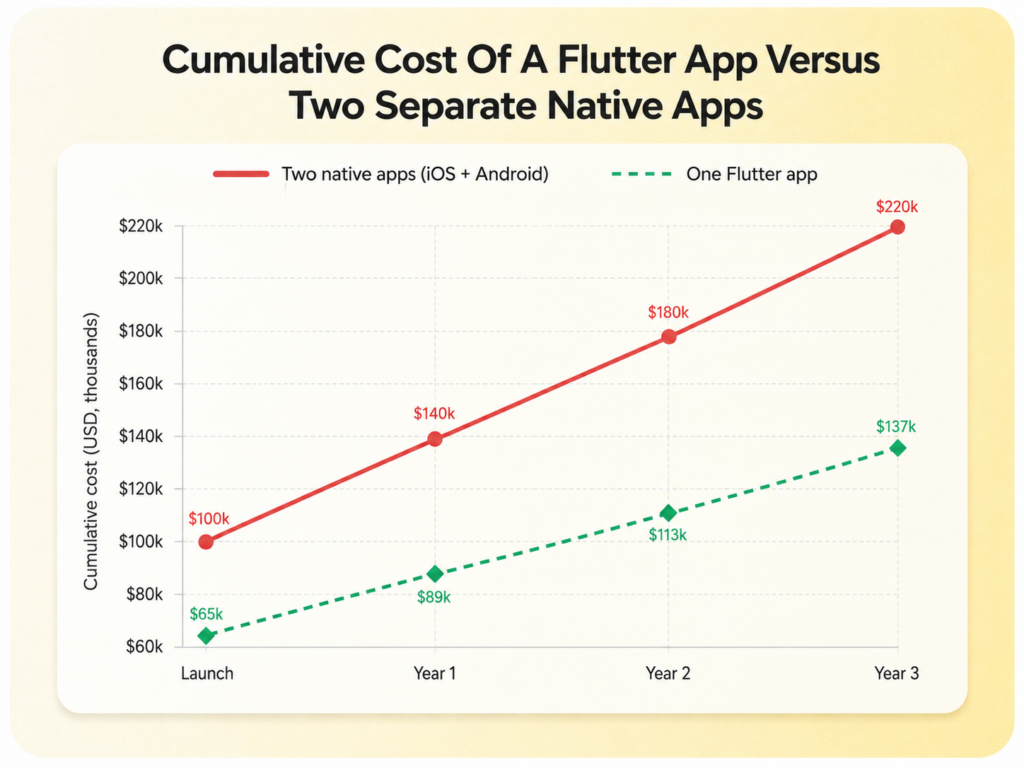 Three-year cumulative cost comparison of a Flutter app versus separate iOS and Android native apps
What Should a Startup Check Before Hiring?
Once you know the budget, the next risk is hiring the wrong team. A few checks separate developers who can ship a production Flutter app from those who only build demos. Run through these before you sign anything.
Shipped apps in both stores
Ask for live links, not screenshots. A credible Flutter developer can point you to apps published on both the App Store and Google Play that you can download and open right now. Demos and portfolio mockups prove far less than an app real users have rated.
Native integration experience
Pure Dart covers most of an app, but features like camera access, payments, and Bluetooth often need a bridge to native code. Confirm the team has written platform channels before. Without that experience, a build can stall the moment it needs hardware features that Flutter does not wrap out of the box.
Engagement model fit
Match the contract to your stage. A dedicated team works well when scope will keep shifting through discovery and iteration, while a fixed-scope contract fits a tightly defined MVP with clear requirements. Picking the wrong one wastes money: open-ended hourly billing on a fixed spec invites scope creep, and a rigid contract on a fuzzy idea leads to costly change orders.
Conclusion
Flutter gives a startup a real shot at shipping to both platforms with roughly half the team and 30% to 40% less upfront cost, and the maintenance savings keep growing after launch. Your next move is to scope the app to an MVP band, decide how much you can spend, then pick a region and seniority mix that fits. Get those two decisions right and the single codebase takes care of the rest.
FAQ
How much does it cost to hire a Flutter developer in 2026?
Globally, expect $20 to $150 per hour. US developers run $50 to $150, Eastern Europe and Latin America fall around $25 to $70, and India-based talent starts near $20 per hour.
Is Flutter cheaper than building separate iOS and Android apps?
Yes. A single Flutter codebase typically cuts upfront development cost by 30% to 40% and maintenance by about 40%, since you build and update once instead of twice.
How long does it take to build a Flutter MVP?
It depends on scope, but a focused MVP with one core flow usually takes 2 to 4 months with a small team of a designer, one to two developers, and a part-time QA. Adding integrations or custom hardware features pushes that toward 5 to 6 months.
Should a startup hire freelance Flutter developers or a dedicated team?
- Choose a freelancer for a small, well-defined build or a quick prototype under a few thousand dollars.
- Choose a dedicated team when the app has multiple flows, will iterate after launch, or needs ongoing maintenance.
A single freelancer is rarely enough once the app needs design, backend, and QA running in parallel.
Does Flutter work for complex, feature-heavy apps?
Yes. Apps like Google Pay and Alibaba’s Xianyu run on Flutter at large scale. For heavy native needs such as advanced camera processing, plan for platform channels and a senior developer who has built them before.